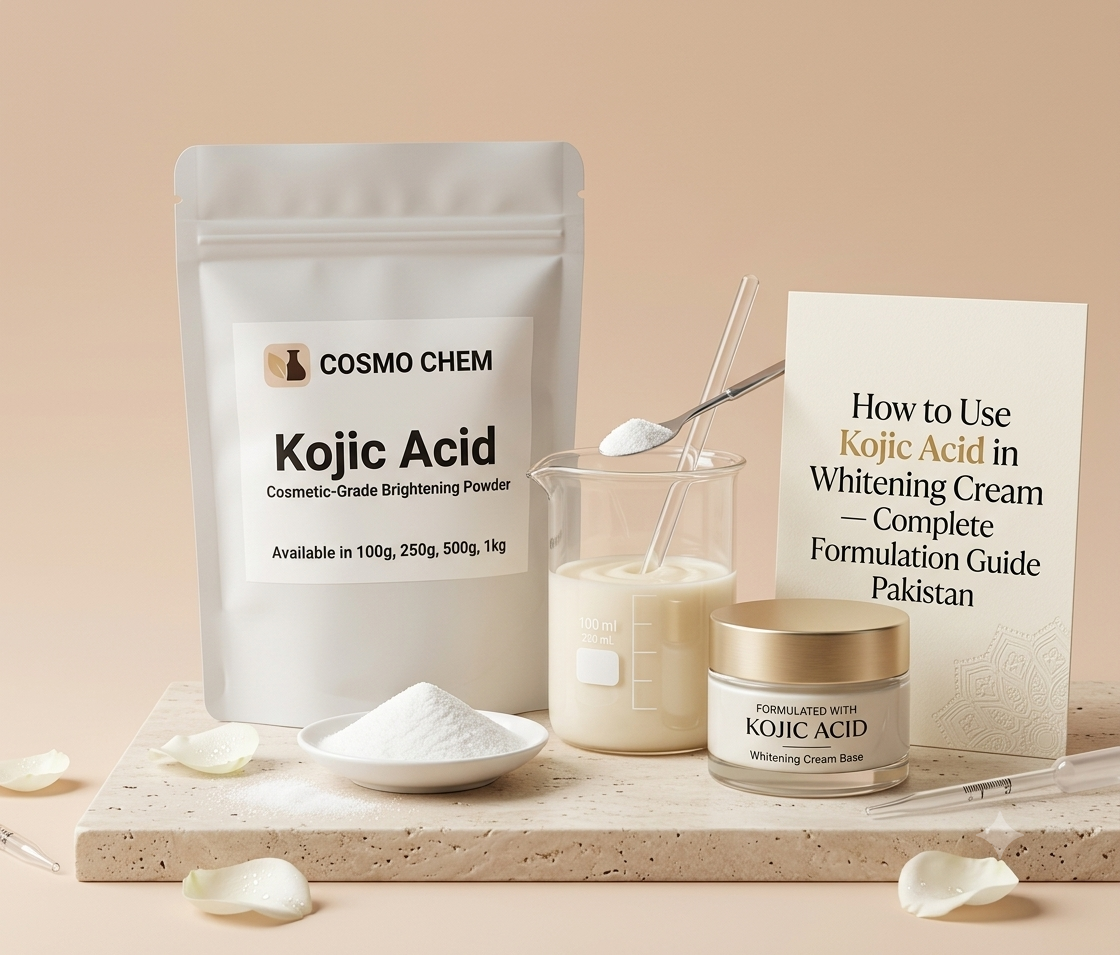
How to Use Kojic Acid in Whitening Cream — Complete Formulation Guide Pakistan

Introduction
Kojic Acid is Pakistan’s most in-demand skin brightening raw material — and for good reason. It is the active ingredient behind almost every successful whitening cream, serum, and soap formula in the local and South Asian market. But using it correctly in a cream formulation requires understanding the right percentage, pH range, compatible ingredients, and processing method.
This complete formulation guide is written specifically for cosmetic manufacturers, soap makers, and brand developers in Pakistan who want to create a stable, effective, and commercially successful Kojic Acid whitening cream using locally available raw materials.
What is Kojic Acid — Quick Overview
Kojic Acid is a naturally derived organic acid produced during the fermentation of rice — the same process used to make sake and rice vinegar in Japan. In cosmetics, it works as a tyrosinase inhibitor — it blocks the enzyme responsible for melanin production in skin cells. Less melanin means lighter, more even-toned skin over consistent use.
| Property | Details |
|---|---|
| INCI Name | Kojic Acid |
| CAS Number | 501-30-4 |
| Appearance | White crystalline powder |
| Solubility | Water soluble |
| Working pH | 3.5 – 5.5 |
| Recommended Usage | 0.5% – 2.0% in creams |
| Stability | Sensitive to light, air, and high pH |
Important for Pakistani manufacturers: Kojic Acid is legally permitted for cosmetic use in Pakistan and is widely used in OTC whitening products. It is also compliant with EU Cosmetic Regulations at concentrations up to 1% in face creams.
Why Kojic Acid is the #1 Whitening Active in Pakistan
Before jumping into the formula, it is important to understand why formulators across Lahore, Karachi, and Faisalabad prefer Kojic Acid over other brightening actives:
Proven Efficacy: Decades of clinical use and consumer results make it one of the most trusted whitening actives globally.
Label Appeal: Pakistani consumers recognise and trust the name “Kojic Acid” — having it on your label drives purchase decisions and justifies premium pricing.
Cost Effective: Effective at just 1%, it delivers visible results at low raw material cost per unit — important for competitive local manufacturing.
Versatile: Works in creams, serums, soaps, face masks, and body lotions — one active that serves multiple product lines.
Widely Available in Bulk: Available in wholesale quantities from suppliers like Cosmo Chem in Lahore — ensuring consistent supply for your production needs.
Complete Kojic Acid Whitening Cream Formula
This is a professionally developed base formula suitable for day or night whitening cream production. All percentages are by weight.
Phase A — Water Phase
| Ingredient | % by Weight | Purpose |
|---|---|---|
| Distilled Water | 68.5% | Base / solvent |
| Glycerin | 5.0% | Humectant — skin hydration |
| Hyaluronic Acid Powder | 0.5% | Deep hydration, plumping |
| Niacinamide | 3.0% | Brightening + barrier support |
| Allantoin | 0.2% | Soothing, skin repair |
Phase B — Oil Phase
| Ingredient | % by Weight | Purpose |
|---|---|---|
| Cetyl Alcohol | 3.0% | Emulsion stabiliser, texture |
| Stearic Acid | 2.0% | Emulsifier support, body |
| Emulsifying Wax NF | 5.0% | Primary emulsifier |
| Sweet Almond Oil | 5.0% | Skin nourishment |
| Dimethicone 350 | 1.0% | Silky skin feel |
Phase C — Cool Down Phase (Add below 40°C)
| Ingredient | % by Weight | Purpose |
|---|---|---|
| Kojic Acid | 1.0% | Primary brightening active |
| Vitamin C (Ascorbic Acid) | 0.5% | Kojic Acid stabiliser + booster |
| Ferulic Acid | 0.1% | Antioxidant — prevents oxidation |
| Preservative (Phenoxyethanol) | 0.8% | Broad spectrum preservation |
| Fragrance Oil (optional) | 0.3% | Scent |
| Lactic Acid / Citric Acid | q.s. | pH adjustment to 3.8 – 4.5 |
Total: 100%
Step by Step Manufacturing Process
Step 1 — Prepare Phase A
Weigh distilled water into your main mixing vessel. Add Glycerin, Allantoin, and Niacinamide. Heat to 75–80°C with slow mixing until all ingredients dissolve completely. Add Hyaluronic Acid by sprinkling slowly onto the warm water surface and mixing until fully dissolved.
Step 2 — Prepare Phase B
In a separate vessel, weigh all oil phase ingredients together. Heat to 75–80°C until all waxes and butters melt completely and the phase becomes uniform and clear.
Step 3 — Emulsification
With both phases at the same temperature (75–80°C), slowly pour Phase B into Phase A with continuous mixing. Use a homogeniser or high-speed mixer for 3–5 minutes to form a stable, uniform emulsion. Continue slow mixing as the batch cools.
Step 4 — Cool Down
Continue mixing slowly as the batch cools. When temperature reaches below 40°C — this is critical — begin adding Phase C ingredients one by one. Start with Kojic Acid pre-dissolved in a small amount of warm water, then add Vitamin C, Ferulic Acid, preservative, and fragrance.
Step 5 — pH Adjustment
Check pH using a calibrated pH meter. Your target is pH 3.8 – 4.5. If pH is too high, add Lactic Acid solution dropwise with mixing until target is reached. This step is non-negotiable — Kojic Acid loses efficacy rapidly above pH 5.5.
Step 6 — Final QC Check
Check appearance (smooth, uniform, no lumps), pH (3.8–4.5), and colour (should be white to very pale yellow). Any significant yellowing indicates Kojic Acid oxidation — check your cool-down temperature and antioxidant levels.
Step 7 — Fill and Pack
Fill into airless pump bottles or aluminum tubes. Airless packaging is strongly recommended — it prevents oxidation and extends product shelf life significantly. Opaque or amber packaging adds additional protection from light degradation.
Critical Formulation Tips for Pakistani Manufacturers
pH is Everything
The single most common reason Kojic Acid creams fail — either turning yellow or losing efficacy — is incorrect pH. Always adjust to pH 3.8–4.5 and verify with a calibrated pH meter. Do not rely on pH strips for this — they are not accurate enough for Kojic Acid formulations.
Always Add Kojic Acid in Cool Phase
Kojic Acid degrades rapidly at temperatures above 40°C. Adding it during the hot phase destroys active potency before the cream is even packaged. Always cool your batch below 40°C before adding any active ingredients.
Use Vitamin C as a Stabiliser
Kojic Acid oxidises easily — it turns cream yellow and loses efficacy. Adding 0.5% Ascorbic Acid (Vitamin C) acts as a natural antioxidant that protects Kojic Acid and extends its active life in the formulation. Ferulic Acid at 0.1% adds additional protection.
Use Airless Packaging
Oxygen is the enemy of Kojic Acid stability. Standard open jars allow air contact every time the consumer uses the product — accelerating yellowing and degradation. Airless pumps extend product shelf life from 3–6 months to 12+ months.
Start Stability Testing Early
Before scaling to full production batch, test your formula at 40°C for 4 weeks (accelerated stability testing). If the cream stays white and maintains pH, it is stable. If it yellows within 2 weeks, increase your antioxidant level or recheck pH.
Ingredient Sourcing in Pakistan
All raw materials used in this formula are available in wholesale bulk quantities from Cosmo Chem in Lahore — including:
- Kojic Acid — cosmetic grade, 99% purity
- Hyaluronic Acid Powder — cosmetic grade
- Niacinamide — USP grade
- Glycerin — cosmetic grade
- Emulsifying Wax NF — cosmetic grade
- Ferulic Acid — cosmetic grade
- Vitamin C / Ascorbic Acid — cosmetic grade
We supply to manufacturers across Lahore, Karachi, Faisalabad, Islamabad, Multan, and all major industrial cities. WhatsApp us for today’s bulk price list.
FAQs
Q: What is the correct percentage of Kojic Acid in a whitening cream?
For daily-use whitening creams, 1.0% is the standard effective concentration recommended by cosmetic dermatologists. You can use up to 2.0% in intensive treatment night creams. Going above 2% does not improve results and increases the risk of skin sensitivity — especially for Pakistani consumers with medium to dark skin tones.
Q: Why does my Kojic Acid cream turn yellow?
Yellowing means Kojic Acid has oxidised — caused by one of three things: adding Kojic Acid while the batch was still above 40°C, formulating at pH above 5.5, or using standard open-jar packaging that allows air exposure. Fix all three — cool phase addition, pH 3.8–4.5, and airless packaging — and yellowing stops.
Q: Can I use Kojic Acid in soap?
Yes, but with significant limitations. Kojic Acid is unstable in the high-alkaline environment of cold process soap (pH 12–14). It degrades rapidly and will not deliver brightening results. For soap-based brightening products, use Kojic Acid Dipalmitate instead — it is the stable ester form specifically designed for high-pH soap formulations.
Q: Can I combine Kojic Acid with Glutathione in the same cream?
Yes — this is actually a very popular combination in Pakistan’s whitening product market. Use Kojic Acid at 1% and Glutathione at 1–2% in the same cool-down phase. Both require pH 3.5–5.0 and cool-phase addition, so they are highly compatible in a single formulation. The combination targets two separate melanin pathways simultaneously for stronger brightening results.
Q: How long does it take to see results from a Kojic Acid whitening cream?
Visible results typically appear after 4–8 weeks of consistent daily use. Kojic Acid works by gradually reducing melanin production — it does not bleach skin immediately. Manufacturers should communicate this timeline clearly on packaging to manage consumer expectations and reduce return rates.
Q: Is Kojic Acid safe for all skin types?
Kojic Acid is generally safe for all skin types at 1% concentration. However, individuals with very sensitive skin may experience mild irritation at concentrations above 1.5%. For sensitive skin formulations, combine Kojic Acid at 0.5% with Niacinamide at 3–5% — Niacinamide reduces potential irritation while adding its own brightening mechanism.
Q: Where can I buy Kojic Acid in bulk in Pakistan?
Cosmo Chem supplies cosmetic-grade Kojic Acid in wholesale bulk quantities from our Lahore warehouse. We deliver nationwide to manufacturers in Karachi, Faisalabad, Islamabad, Multan, and all major cities. Contact us on WhatsApp for today’s confirmed bulk price.
Conclusion
A well-formulated Kojic Acid whitening cream is one of the highest-margin and highest-demand products a cosmetic manufacturer in Pakistan can produce. The key to success is not just the ingredient — it is correct pH, cool-phase addition, antioxidant protection, and proper airless packaging working together to deliver a stable, effective, and commercially premium product.
Cosmo Chem supplies all the raw materials needed for this formulation in bulk wholesale quantities — with nationwide delivery across Pakistan. WhatsApp us today for a complete raw material price list and place your first order.