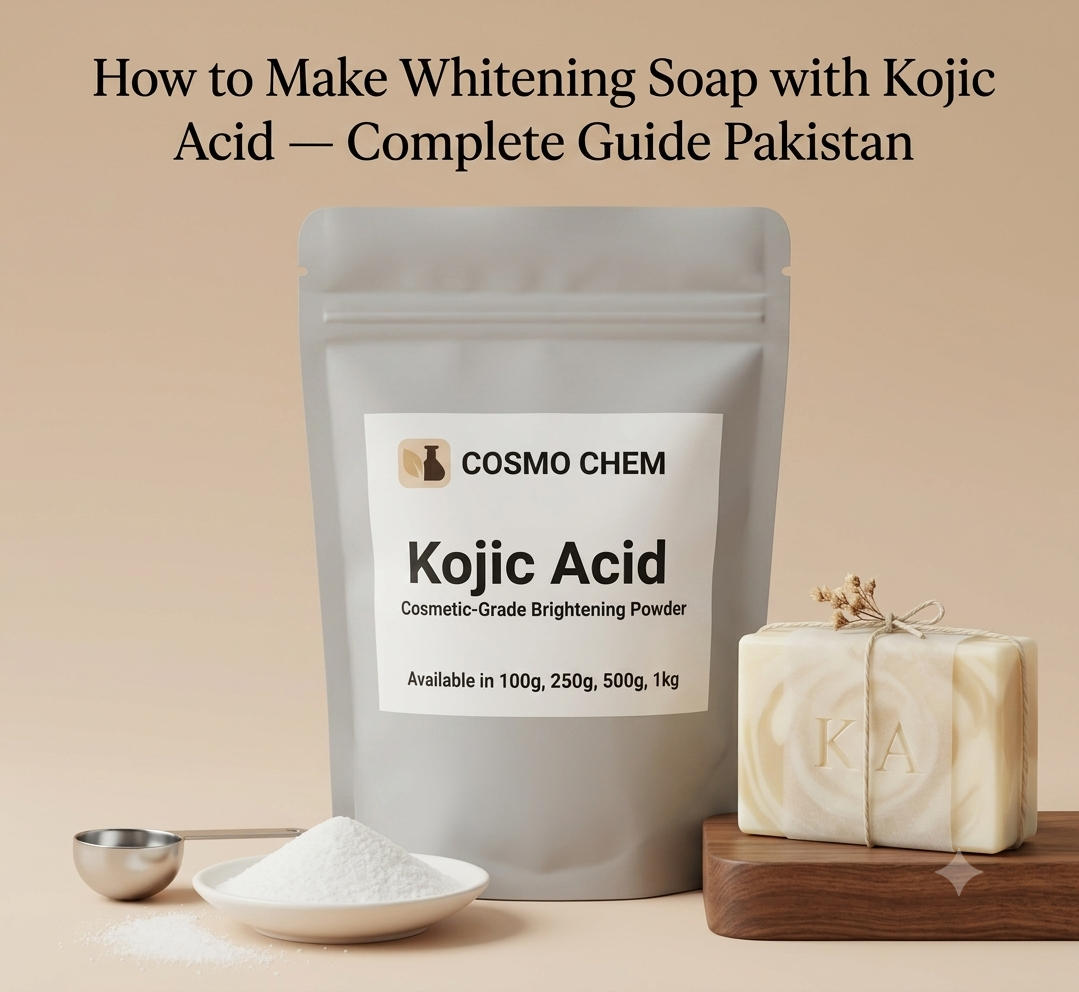
How to Make Whitening Soap with Kojic Acid — Complete Guide Pakistan

Introduction
Whitening soap is one of the highest-selling personal care products in Pakistan — and how to make whitening soap with Kojic Acid Pakistan is one of the most searched DIY and manufacturing queries in the country. From small home-based soap makers in Lahore to large-scale soap factories in Karachi and Faisalabad, Kojic Acid is the #1 active ingredient for skin brightening soap formulations.
But here is what most beginners do not know — regular Kojic Acid powder does not work in cold process soap. The high-alkaline saponification environment destroys it completely before the soap even cures. The correct ingredient for soap making is Kojic Acid Dipalmitate — the stable ester form specifically engineered for high-pH soap formulations.
This complete guide covers both methods — Melt and Pour for beginners and Cold Process for advanced manufacturers — with complete formulas, step by step instructions, and professional tips for making a stable, effective, commercially successful whitening soap in Pakistan.
Why Kojic Acid is the #1 Whitening Soap Active in Pakistan
Before jumping into the formula, understanding why Kojic Acid dominates Pakistan’s whitening soap market helps manufacturers make better product decisions.
Consumer Recognition: Pakistani consumers actively search for “Kojic Acid soap” — the ingredient name itself drives purchase decisions. Products featuring Kojic Acid on the label command premium pricing and higher consumer trust.
Proven Brightening Results: Kojic Acid inhibits tyrosinase — the enzyme responsible for melanin production — delivering visible skin brightening results with consistent daily use over 4–8 weeks.
Versatile: Works in both Melt and Pour and Cold Process soap bases — with the correct form of Kojic Acid for each method.
High Margin Product: Whitening soaps command Rs 300–800 per bar at retail — significantly higher than regular soaps — making it one of the highest-margin products a soap manufacturer can produce.
Kojic Acid vs Kojic Acid Dipalmitate — Critical Difference for Soap Makers
This is the most important thing every Pakistani soap manufacturer must understand before starting:
| Factor | Kojic Acid | Kojic Acid Dipalmitate |
|---|---|---|
| Form | Pure acid — water soluble | Ester — oil soluble |
| pH Stability | Unstable above pH 6 | Stable up to pH 10+ |
| Cold Process Soap Suitability | ❌ Not suitable — destroyed by high pH | ✅ Ideal — stable in alkaline environment |
| Melt and Pour Suitability | ✅ Suitable at low pH bases | ✅ Excellent in all MP bases |
| Usage Rate in Soap | 1–2% (MP only) | 1–3% |
| Appearance | White powder | White to cream powder |
| Solubility | Water phase | Oil phase |
Bottom Line:
- Melt and Pour Soap — you can use regular Kojic Acid at 1–2% if the base has near-neutral pH
- Cold Process Soap — always use Kojic Acid Dipalmitate — regular Kojic Acid is completely destroyed during saponification
Method 1 — Melt and Pour Whitening Soap (Beginner Friendly)
Melt and Pour (MP) is the easiest entry point for whitening soap production in Pakistan. It requires no lye handling, no curing time, and produces a professional finished product quickly.
Complete Formula — Melt and Pour Kojic Acid Whitening Soap
| Ingredient | % | Purpose |
|---|---|---|
| Melt and Pour Soap Base (Clear or White) | 85% | Base |
| Kojic Acid Dipalmitate | 2.0% | Primary brightening active |
| Niacinamide | 1.0% | Secondary brightening + barrier support |
| Glycerin | 3.0% | Additional moisture — prevents drying |
| Vitamin E Oil (Tocopherol) | 1.0% | Antioxidant — extends shelf life |
| Turmeric Extract (optional) | 0.5% | Natural brightening boost |
| Fragrance Oil | 1.5% | Scent |
| Titanium Dioxide (optional) | 1.0% | White opacity — if using clear base |
| Distilled Water | q.s. | Adjust consistency |
Total: 100%
Step by Step — Melt and Pour Method
Step 1 — Cut and Melt Base
Cut your MP soap base into small chunks for even melting. Place in a heat-safe container and melt using a double boiler or microwave in 30-second bursts. Heat to 60–65°C until fully melted. Do not overheat — above 70°C the base degrades and produces a grainy final soap.
Step 2 — Add Oil Phase Ingredients
While the base is still liquid and hot (60–65°C), add Kojic Acid Dipalmitate, Vitamin E Oil, and any oil-soluble ingredients. Stir gently until fully dispersed — Kojic Acid Dipalmitate is oil-soluble so it blends smoothly into the melted base.
Step 3 — Cool Down to 50°C
Allow the melted base to cool to 50°C with gentle stirring. At this temperature it is still fully liquid but cool enough for heat-sensitive ingredients.
Step 4 — Add Cool Phase Ingredients
At 50°C add Niacinamide, Glycerin, Fragrance Oil, and Turmeric Extract. Stir gently to incorporate evenly.
Step 5 — Add Titanium Dioxide (Optional)
If you want an opaque white soap from a clear base, pre-mix Titanium Dioxide with a small amount of glycerin to form a smooth paste, then add to the soap mixture and stir thoroughly to eliminate white streaks.
Step 6 — Pour into Moulds
Pour immediately into your soap moulds. Spritz the surface with isopropyl alcohol to remove air bubbles. Allow to cool at room temperature for 2–4 hours.
Step 7 — Unmould and Package
Once fully set and firm, unmould and package immediately. MP soaps do not require a curing period — they are ready to use and sell as soon as they are set and hardened.
Method 2 — Cold Process Whitening Soap (Advanced / Factory Scale)
Cold Process (CP) soap produces a harder, longer-lasting bar with better lather characteristics — preferred for commercial manufacturing at scale. It requires lye (Sodium Hydroxide) handling and a 4–6 week cure time.
Complete Formula — Cold Process Kojic Acid Whitening Soap
Oil Phase (Total Oils = 70% of formula)
| Oil | % of Total Oils | Purpose |
|---|---|---|
| Coconut Oil | 30% | Hard bar, rich lather |
| Palm Oil | 25% | Hardness, stable lather |
| Olive Oil | 25% | Conditioning, skin nourishment |
| Castor Oil | 10% | Lather boost, moisture |
| Sweet Almond Oil | 10% | Skin softening |
Lye Solution (25% of formula)
| Ingredient | Amount |
|---|---|
| Sodium Hydroxide (NaOH) | Calculated per oil weight using soap calculator |
| Distilled Water | 2x weight of NaOH |
Active Ingredients — Superfat Phase (5% of formula)
| Ingredient | % of Total Formula | Addition Point |
|---|---|---|
| Kojic Acid Dipalmitate | 2.0% | Add to oils before trace |
| Vitamin E Oil | 1.0% | Add to oils before trace |
| Niacinamide | 0.5% | Dissolve in small water portion, add at light trace |
| Fragrance Oil | 1.5% | Add at light trace |
Step by Step — Cold Process Method
Step 1 — Safety First
Always wear full PPE before handling lye — safety goggles, chemical-resistant gloves, and long sleeves. Lye causes severe burns on contact with skin or eyes. Work in a well-ventilated area.
Step 2 — Prepare Lye Solution
Always add lye TO water — never water to lye. Stir slowly until fully dissolved. The solution will heat to 80–90°C immediately — this is normal. Set aside to cool to 40–45°C.
Step 3 — Melt and Prepare Oils
Melt solid oils (Coconut Oil, Palm Oil) and combine with liquid oils. Heat to 40–45°C. Add Kojic Acid Dipalmitate and Vitamin E Oil directly to the warm oil phase and stir until fully dissolved — both are oil-soluble and disperse perfectly in the oil phase.
Step 4 — Combine Lye and Oils
When both lye solution and oils are at the same temperature (40–45°C), slowly pour lye solution into oils with stick blender mixing. Alternate between stick blending and hand stirring until light trace is reached — a light custard-like consistency.
Step 5 — Add Remaining Actives at Light Trace
At light trace add Niacinamide (pre-dissolved in small water portion) and Fragrance Oil. Mix thoroughly with hand stirring to maintain light trace consistency.
Step 6 — Pour into Moulds
Pour immediately into lined soap moulds. Cover with a cardboard lid and wrap in a towel or blanket to insulate — this maintains the heat needed for complete saponification.
Step 7 — Unmould After 24–48 Hours
After 24–48 hours the soap should be firm enough to unmould. Cut into bars immediately after unmoulding.
Step 8 — Cure for 4–6 Weeks
Cold process soap must cure for minimum 4 weeks — 6 weeks is ideal. During curing, excess water evaporates, the bar hardens, and the pH drops from highly alkaline to skin-safe levels. Do not use or sell before 4 weeks.
Professional Tips for Pakistani Soap Manufacturers
Always Use Kojic Acid Dipalmitate in Cold Process
Regular Kojic Acid powder is completely destroyed during cold process saponification. The lye creates a high-alkaline environment (pH 12–14) that breaks down Kojic Acid molecules within minutes. Kojic Acid Dipalmitate is specifically engineered to survive this environment and deliver brightening activity in the final cured soap.
Fragrance Selection Matters
Some fragrance oils accelerate trace in cold process soap — causing the batch to seize before it can be poured into moulds. Always test new fragrance oils in a small 200g test batch before using in full production. Safe fragrance loads for CP soap are 1–3% of total oil weight.
pH Testing Before Selling
Always test your cold process soap pH before packaging and selling. Target pH 8–10 for a cured CP soap. Above pH 10 the soap is still too alkaline and can irritate skin. Use pH strips or a pH meter on a solution of soap and distilled water.
Water Discount for Harder Bars
Using less water in your lye solution (water discount of 20–30%) produces harder bars that unmould faster, cure faster, and last longer. Standard water amount is 2x lye weight — water discount means using 1.5–1.7x lye weight instead.
Titanium Dioxide for White Bars
For a clean white commercial appearance, pre-mix Titanium Dioxide at 1–2% with a small portion of your liquid oils to form a smooth paste, then add to your oils before combining with lye. This eliminates white streaks and produces a uniformly white bar.
Packaging and Labelling for Commercial Sale Pakistan
For commercial sale in Pakistan, your whitening soap packaging must include:
| Label Element | Requirement |
|---|---|
| Product Name | Kojic Acid Whitening Soap |
| Net Weight | Weight in grams |
| Ingredients List | INCI names in descending order |
| Manufacturer Name & Address | Required |
| Manufacturing Date | Required |
| Expiry / Best Before | Required |
| Usage Instructions | How to use |
| Warnings | Keep away from eyes, external use only |
Packaging tip: Shrink wrap individual bars with a custom printed label — this is the most cost-effective professional packaging for small to medium scale soap production in Pakistan.
Where to Buy Kojic Acid Soap Making Ingredients Wholesale in Pakistan
All raw materials needed for whitening soap production — including Kojic Acid Dipalmitate, Niacinamide, Glycerin, Vitamin E Oil, Melt and Pour Soap Base, and Fragrance Oils — are available in bulk wholesale quantities from Cosmo Chem in Lahore.
We supply to soap manufacturers, home-based soap makers, and cosmetic factories across Lahore, Karachi, Faisalabad, Islamabad, Multan, and all major cities nationwide.
👉 [Buy Kojic Acid Dipalmitate Wholesale — Click Here]
👉 [Buy Kojic Acid Wholesale — Click Here]
👉 [Buy Niacinamide Wholesale — Click Here]
👉 [Buy Glycerin Wholesale — Click Here]
WhatsApp us today for confirmed bulk pricing and same-day dispatch on in-stock items.
FAQs
Q: How to make whitening soap with Kojic Acid Pakistan — which method is best for beginners?
Melt and Pour is always recommended for beginners. It requires no lye handling, no curing time, and produces professional results quickly. Once you are comfortable with formulation and ingredient ratios, progress to Cold Process for commercial-scale production with better bar quality and lower raw material cost per unit.
Q: Can I use regular Kojic Acid powder in cold process soap?
No — absolutely not. Regular Kojic Acid is an acid that is completely destroyed in the high-alkaline saponification environment of cold process soap (pH 12–14). It will not deliver any brightening benefit in the final soap. Always use Kojic Acid Dipalmitate for cold process soap — it is the stable ester form specifically designed for alkaline soap formulations.
Q: What percentage of Kojic Acid Dipalmitate should I use in soap?
Use 1–3% Kojic Acid Dipalmitate in both Melt and Pour and Cold Process soap formulations. Starting at 2% is recommended — this delivers visible brightening results without excessive cost. Going above 3% does not improve results and increases raw material cost unnecessarily.
Q: How long does it take to see results from Kojic Acid whitening soap?
Visible skin brightening results from consistent daily use of Kojic Acid soap typically appear within 4–8 weeks. Because soap is a rinse-off product with limited contact time on skin, results take slightly longer than leave-on serums or creams. Consistent twice-daily use accelerates results.
Q: Can I add turmeric to my Kojic Acid whitening soap?
Yes — Turmeric Extract (not raw turmeric powder) at 0.5–1% pairs well with Kojic Acid Dipalmitate in whitening soap. Both target melanin production through complementary pathways. Use Turmeric Extract rather than raw powder — raw powder creates brown spots in the soap and does not disperse evenly.
Q: What is the wholesale price of Kojic Acid Dipalmitate in Pakistan?
Price varies based on order quantity and market rates. Contact Cosmo Chem on WhatsApp for today’s confirmed bulk wholesale price — we offer competitive rates for soap manufacturers and cosmetic factories across Pakistan.
Q: Do you deliver soap making ingredients to Karachi and Faisalabad?
Yes — Cosmo Chem delivers nationwide to all major cities including Lahore, Karachi, Faisalabad, Islamabad, Multan, Rawalpindi, Sialkot, and beyond via reliable goods transport partners.
Conclusion
How to make whitening soap with Kojic Acid Pakistan — whether through Melt and Pour for quick production or Cold Process for commercial scale — comes down to one critical decision: using Kojic Acid Dipalmitate instead of regular Kojic Acid for any alkaline soap base. Get this right and you have a stable, effective, commercially successful whitening soap formula that Pakistani consumers actively search for and are willing to pay premium prices for.
Cosmo Chem supplies all whitening soap raw materials in bulk wholesale quantities from our Lahore warehouse — with nationwide delivery across Pakistan. WhatsApp us today for a complete ingredient price list.